
Share
10 min read
SB 54 Is Live. Here’s What It Actually Means for Your Business and Your Bins.
California’s SB 54 the Plastic Pollution Prevention and Packaging Producer Responsibility Act stopped being theoretical on May 1, 2026. That’s when the final regulations took effect and the compliance clock started ticking for real. If your company’s name is on a product sold in California, and that product comes in any kind of single-use plastic packaging, this law has your attention whether you want it to or not.
We’ve been watching this law develop since it was signed by Governor Newsom back in June 2022. For almost four years, it existed as statute without teeth the regulations that would actually define who owes what, when, and how kept getting revised, withdrawn, and reopened for public comment. Businesses were genuinely stuck: the law was real but the rulebook kept changing. That ambiguity is gone now. CalRecycle filed the final regulations on May 1, 2026, and they’re enforceable. The only question left is whether your organization is ready.
What surprises a lot of people is how broad the law’s reach actually is. CalRecycle thinks more than 5,700 businesses qualify as “producers” under SB 54. That number includes the obvious ones your major CPG companies, national food and beverage brands but it also picks up importers, private-label retailers, brand licensors, and plenty of mid-size businesses that genuinely didn’t see this coming. If your brand name appears on packaging that contains plastic and that packaging ends up in California, there’s a real chance you’re in scope.
This guide is our attempt to cut through the regulatory complexity and explain SB 54 in plain terms what it requires, who it covers, what the timeline looks like, and what it means for anyone managing recycling infrastructure in California right now.
Why SB 54 Is Different From Every Other Packaging Law
This isn’t just another recycling mandate
There have been packaging laws before. What makes SB 54 genuinely different is the combination of things it requires simultaneously. It’s not just “make your packaging recyclable.” It’s not just “fund recycling infrastructure.” It does both of those things, and it also mandates an actual volume reduction in plastic packaging, bans specific product categories that miss recycling rate targets, and requires producers to collectively pump $500 million per year into a dedicated pollution remediation fund. No other state has attempted all four levers at once.
The other thing worth understanding is that this law doesn’t really stay in California. On paper, SB 54 is a California statute. In practice, most companies can’t justify running two separate packaging systems one for California and one for everywhere else. When the state with the world’s fourth-largest economy sets a packaging standard, the rest of the country usually ends up following it over time. We’re already seeing EPR packaging bills in at least ten other states that are explicitly modeled on what California is doing. If you think your business is outside California’s reach, it might be worth checking that assumption.
The Fundamental Shift
Before SB 54, California taxpayers and local governments paid to manage the recycling of packaging that companies put into the market. Under SB 54, the companies that create the packaging pay for it. That’s the whole restructuring in one sentence.
Are You a “Producer” Under SB 54? The Definition Is Wider Than You Think
Who SB 54 covers and who gets surprised by it
This is where a lot of businesses make a costly assumption. They hear “producer” and assume the law is talking about the company that runs the manufacturing plant. That’s not how SB 54 defines the term. Under the law, you’re a producer if you do any of the following:
- →You manufacture a product in plastic packaging and sell it in California
- →You import plastic-packaged products into California for sale
- →You license your brand name to appear on a product sold in plastic packaging in California
- →You sell products in covered packaging where no one else in your supply chain meets the definition above
Notice what’s not in that list: “you built the plastic yourself.” The law explicitly states that producer status can attach to companies that never touched the manufacturing process. That’s the part that catches importers and private-label retailers off guard. Law firm Benesch flagged this specifically in their May 2026 analysis, warning that the broad definition “creates potential compliance exposure for a wide range of businesses” including ones who haven’t assessed their status yet.
There is a small producer carveout businesses with under $1 million in California gross sales can apply for an exemption. But here’s the catch: you still have to register with CalRecycle to claim it. The exemption isn’t automatic. CalRecycle’s screening tool is a good starting point if you’re genuinely unsure which category you fall into.
producers estimated in scope by CalRecycle
covered material categories in CalRecycle’s list
per year into the Plastic Pollution Mitigation Fund, 2027 to 2037
What SB 54 Actually Requires: Four Mandates That Work Together
This is not a single checkbox it’s a system
25% Less Plastic Packaging by 2032
This is the requirement that catches people off guard the most. It’s not enough to redesign your plastic packaging so it can be recycled. SB 54 requires producers to collectively put 25% less plastic packaging into the California market by 2032 compared to 2023 volumes. That’s a weight reduction target. Less material in circulation, period. The first checkpoint is 10% by January 1, 2027, so the pressure is already real. Businesses can hit the source reduction target through lightweighting, eliminating excess packaging layers, switching to reusables, or replacing plastic with other materials altogether. The path is flexible; the destination is fixed.
100% of Covered Packaging Must Be Recyclable or Compostable by 2032
CalRecycle published an updated Covered Material Categories List in December 2025 classifying 95 categories of packaging. Of those, 45 are currently considered recyclable and 21 compostable which means a meaningful portion of what’s on the market right now doesn’t qualify under either. Black plastic containers, PVC packaging, most multi-layer composite films, plastics with certain chemical additives: these are the problem categories. If they can’t be redesigned to meet recyclability or compostability standards by 2032, they can’t be sold in California. For packaging designers, that’s a six-year runway. It sounds like a lot of time until you consider the complexity of reformulating materials and requalifying supply chains.
65% of Plastic Packaging Must Actually Be Recycled by 2032
There’s an important distinction buried in this target. The law doesn’t say 65% of plastic packaging must be recyclable it says 65% must actually be recycled. California’s current plastic recycling rate is nowhere close to that number. Getting there requires not just better packaging design but a fundamental improvement in how plastic packaging is collected, sorted, and processed across the state. That’s partly why the PRO is investing in infrastructure it’s not optional. The math on this target only works if capture rates at the point of disposal improve significantly. Which brings us directly to what facilities managers need to be thinking about.
$500 Million Per Year Into the Plastic Pollution Mitigation Fund
Starting in 2027, the Producer Responsibility Organization collects $500 million annually from producers and remits it to the California Plastic Pollution Mitigation Fund through 2037. An additional $150 million can be levied on plastic resin manufacturers. That’s $5 to $6.5 billion over the life of the program, directed at communities disproportionately impacted by plastic pollution, infrastructure investment, and composting capacity expansion. This funding mechanism is the largest of its kind in any U.S. state law. It’s also why producer fees aren’t symbolic they’re substantial, and they’re tied directly to the volume and recyclability of your packaging.
How Compliance Actually Works: Three Registration Pathways
The Circular Action Alliance, independent registration, and the small producer exemption
SB 54 gives producers three ways to meet their obligations. Most large and mid-size producers will go through the Circular Action Alliance (CAA) the single PRO that CalRecycle selected in January 2024. Joining the CAA means delegating most of your compliance obligations to a collective body, submitting supply data, and paying fees calculated based on the type and recyclability of your packaging. It’s simpler than the alternatives and it’s the path most businesses will take.
| Pathway | Best For | What It Involves |
|---|---|---|
| Join the CAA (PRO pathway) | Most producers with significant packaging volumes | Register with CAA, submit supply data, pay fees based on material type and recyclability; CAA handles collective obligations |
| Independent registration | Producers who want direct control over compliance | Register via CalRecycle’s PEPRS portal; submit data directly; manage all program requirements independently |
| Small producer exemption | Producers with under $1M in California gross sales | Register with CalRecycle via PEPRS and apply for the exemption registration is still mandatory even if you qualify |
The CAA submitted its draft California Program Plan to the SB 54 Advisory Board on June 15, 2026. There’s a public comment period running until August 14, 2026. CalRecycle has to approve the plan by January 1, 2027, at which point the full EPR program begins. The CAA is also running the California Recycling and Reuse System Optimization Project (CARRSOP) to figure out how to actually build the collection and sorting infrastructure needed to reach a 65% recycling rate which, as we noted above, California currently isn’t anywhere near.
The Sales Restriction Is Real
From January 1, 2027, producers who haven’t registered and aren’t participating in an approved program plan can’t sell covered materials in California. This is not a fine. It’s a ban on selling. That consequence alone should be enough to push any remaining holdouts into registration.
Expanded Polystyrene Is Already Banned. Not “Being Phased Out.” Banned.
The first major product prohibition under SB 54 is already in effect
This section is worth reading carefully because the timeline confuses people. SB 54 set a specific benchmark for expanded polystyrene (EPS) foam food service ware: producers had to demonstrate a 25% recycling rate for all EPS sold into California before January 1, 2025. That demonstration wasn’t made. As a result, EPS food service ware is now prohibited from sale, distribution, and importation in California. Not scheduled for removal. Not under review. Prohibited now.
What does that mean in practice? If your office, cafeteria, campus, or food service operation in California is still using foam cups, foam clamshells, foam plates or bowls those are coming in illegally. Your supplier shouldn’t be selling them to you for California use. You need to switch to alternatives: paper-based food service ware, certified compostable containers, or reusable programs. And when you make that switch, your recycling and waste bins need to reflect it. Compostable food service ware goes in the organics bin, not the recycling bin. The signage on your stations needs to keep up with the materials your people are actually holding.
There’s also a waste stream angle here that’s easy to miss. EPS foam crumbles. When it gets into a recycling bin it turns into tiny white beads that contaminate everything around it and are nearly impossible to sort out at a MRF. Getting EPS out of your supply chain eliminates the contamination problem at the source, which is always a better outcome than trying to manage it downstream.
The SB 54 Timeline at a Glance
Every deadline that matters between now and 2037
| Date | What Happens |
|---|---|
| June 30, 2022 | SB 54 signed into law |
| January 1, 2025 | EPS food service ware banned in California after producers failed to meet 25% recycling rate threshold |
| May 1, 2026 | Final SB 54 regulations approved by OAL and take effect immediately |
| May 31, 2026 | Producers submit 2025 annual supply data and source reduction report |
| June 1, 2026 | Producer registration deadline CAA, independent, or small producer exemption application required |
| June 15, 2026 | CAA submits draft California Program Plan; public comment opens until August 14, 2026 |
| August 1, 2026 | Individual Source Reduction Plans due |
| January 1, 2027 | CalRecycle approves program plan; EPR program fully begins; non-registered producers banned from selling covered materials; 10% source reduction target active |
| March 1, 2027 | PRO remits first Plastic Pollution Mitigation Fund fees to the state |
| January 1, 2032 | Full targets: 25% source reduction vs. 2023 baseline; 65% actual plastic recycling rate; 100% of covered materials recyclable or compostable |
| 2027 to 2037 | $500M per year into the Plastic Pollution Mitigation Fund; up to $150M additional from resin manufacturers |
What This Means for the Bins in Your Building
SB 54’s targets depend on what happens at the point of disposal
SB 54’s obligations land primarily on producers but the law’s targets cannot be met without better separation happening across millions of disposal decisions every single day in offices, schools, cafeterias, stadiums, and public spaces. The 65% recycling rate target is a collection-side problem just as much as it’s a design problem. You can make packaging perfectly recyclable and still miss that target if it doesn’t get sorted correctly at the bin.
Here’s what changes at the facility level as SB 54 rolls out over the next several years. Black plastic food containers one of the most persistent contamination sources in recycling bins right now because sorting equipment literally can’t see them will disappear from the market as producers switch to clear alternatives to meet recyclability requirements. EPS is already gone. Multi-layer composite packaging that currently has no recyclable end-of-life option will be redesigned. The contamination landscape in your bins will shift because the materials flowing through your space will change.
That’s not a reason to wait on infrastructure improvements. It’s a reason to get ahead of them. Facilities that build clean multi-stream separation now, with proper signage, paired landfill and recycling stations, and dedicated streams for compostable food service ware, are building the separation quality the law needs to hit its 65% target. Those that don’t are actively contributing to the gap.
Plastic Film Is Still a Problem Your Bins Need to Handle
Plastic film from delivery packaging the pallet wrap, poly mailers, bubble wrap, and air pillows that come with virtually every shipment is the largest plastic type in many California county waste streams. SB 54’s source reduction targets will eventually push producers toward reusable or non-plastic alternatives for transport packaging, but that transition takes years. In the meantime, facilities receiving deliveries need a dedicated plastic film collection point separate from single-stream recycling. Film in a recycling bin wraps around sorting equipment and causes shutdowns. It doesn’t get recycled. It causes damage and ends up in landfill anyway.
If You Run a Cafeteria or Food Service Operation, Act Now
EPS is prohibited. If you’re still sourcing it for California use, stop. Beyond that, any food service packaging that won’t qualify as recyclable or compostable by 2032 is on borrowed time. The practical paths are compostable packaging (which requires an organics collection stream and a hauler that accepts compostables), reusable food service ware programs, or recyclable single-use alternatives. Each of these options changes what goes in which bin, what your signage needs to say, and what you need from your hauler. Start those conversations now rather than when a deadline forces your hand.
How CleanRiver Fits In
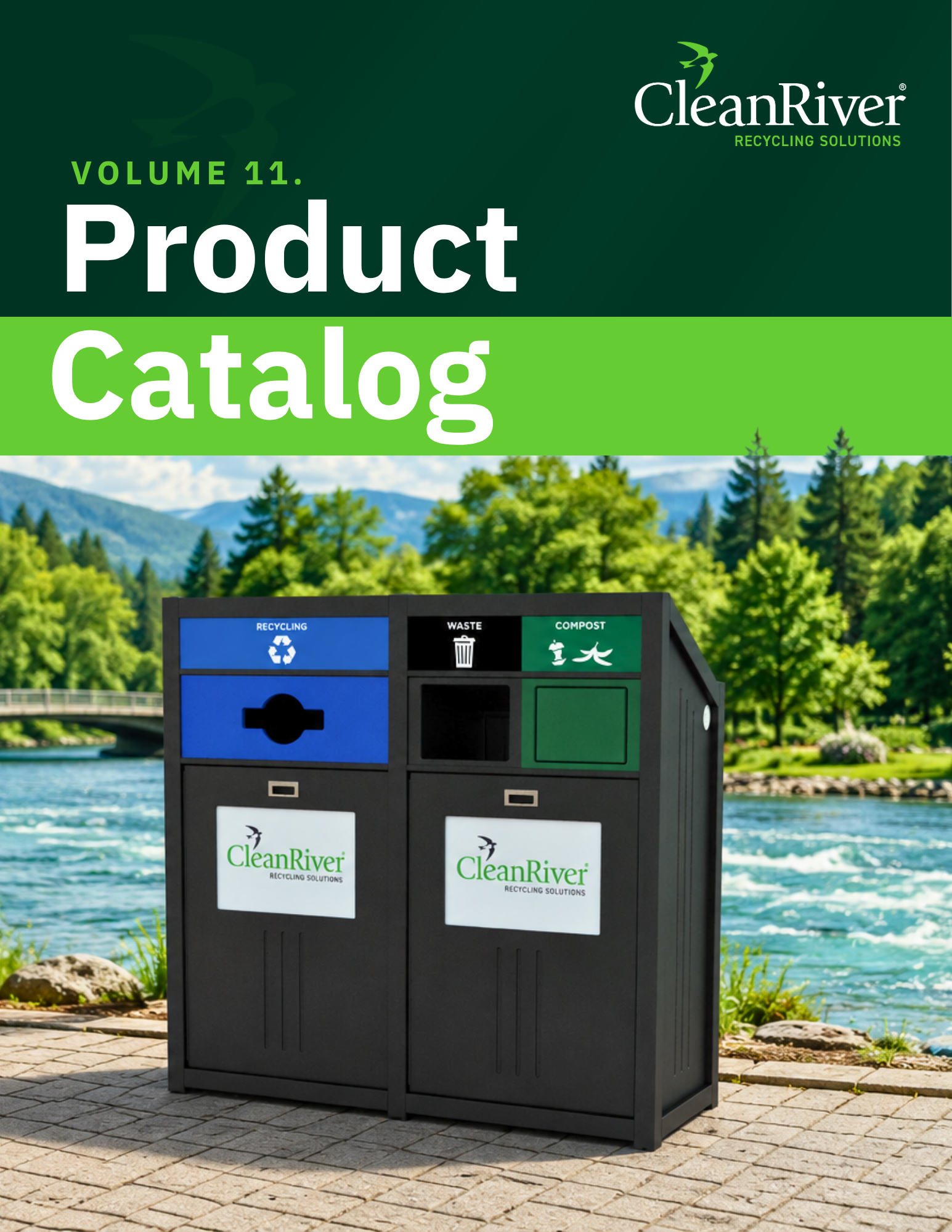
The 65% plastic recycling rate that SB 54 demands can’t be achieved without cleaner source separation at the facility level across California. CleanRiver’s multi-stream collection stations, custom signage, and waste stream assessments are designed to do exactly that: capture more recyclables cleanly, reduce contamination, and deliver the material quality that makes the law’s targets achievable rather than aspirational. Talk to a CleanRiver specialist about your California facility.
Six Things to Do Right Now If You’re in California
| 1 | Find out if you’re a producer. Use CalRecycle’s screening tool. Don’t assume the answer is no just because you’re not a manufacturer. Importers, private-label sellers, and brand licensors have all been surprised by their status. If there’s any doubt, get legal counsel who knows California environmental regulation. |
| 2 | Register if you haven’t already. The June 1, 2026 deadline passed. If you missed it, register now through PEPRS or CAA. Businesses that become producers after June 1 but before January 1, 2027 have 30 days from becoming a producer to register. From January 2027, not being registered means not being able to sell covered materials in California. That’s a hard stop. |
| 3 | Go through your packaging component by component. Check each material against CalRecycle’s Covered Material Categories List. There are 95 categories. Some of your packaging will be fine. Some won’t be. The ones that fall into neither the recyclable nor compostable column need a redesign roadmap that gets you to compliance before 2032. |
| 4 | Reconstruct your 2023 baseline data. Everything your source reduction reports, your Individual Source Reduction Plan, your fee calculations is measured against what you put into the market in 2023. If your data systems weren’t tracking packaging volumes at that level of detail, start reconstructing those figures now. Better baseline data means a more defensible compliance roadmap. |
| 5 | Get EPS out of your supply chain and your food service operation. It’s prohibited. If you’re still sourcing EPS foam cups, clamshells, or plates for California facilities, stop sourcing them now. Switch to paper, certified compostable, or reusable alternatives. And update your bin labels and signage to reflect whatever replaces them compostable food service ware goes in the organics bin, not the recycling bin. |
| 6 | Upgrade your collection infrastructure to match what the law needs. A 65% plastic recycling rate for the whole state requires dramatically cleaner material coming out of buildings across California. Review your current station setup: are streams properly separated? Are bins co-located so people don’t have to walk to find the right container? Is signage clear enough that someone in a hurry still makes the right call? CleanRiver’s multi-stream stations and custom signage are specifically designed to answer yes to all three of those questions. |
SB 54 is genuinely complicated. Four years of regulatory uncertainty followed by a compressed compliance timeline with overlapping deadlines has left a lot of businesses scrambling. We get it. But the underlying idea is actually pretty simple: if you put plastic packaging into California’s economy, you now share responsibility for what happens to it afterward. That’s a reasonable ask, and the law has real mechanisms to enforce it.
Here’s the thing about SB 54 that doesn’t get said enough: the businesses that treat it as a compliance problem are going to spend the next six years in reaction mode, fielding penalties, scrambling to meet deadlines, and retrofitting packaging decisions that should have been made years earlier. The ones that treat it as a design challenge a genuine invitation to rethink how much plastic their products actually need tend to find that the redesign process surfaces cost savings they weren’t expecting, opens supply chain conversations that are long overdue, and positions them better in a market that is visibly moving toward less plastic across the board.
January 1, 2032 is six years away. That sounds like a long time. But getting from where most packaging portfolios are today to 25% less plastic, 65% actually recycled, and 100% recyclable or compostable is a serious undertaking. The organizations starting now will be in a very different position than the ones starting in 2030.
Is your California facility ready for SB 54?
CleanRiver designs multi-stream recycling stations and signage systems that help California facilities capture more recyclables cleanly, reduce contamination, and support the recycling rate targets SB 54 demands.