
Share
8 min read
Denver Just Changed How Your Building Handles Waste. Here’s the Part Nobody Warned You About.
September 1, 2026 will came and go quietly. No parade, no citywide announcement blasted from speakers. But on that date, Denver’s Universal Recycling and Composting Ordinance — the law voters approved by a 70% landslide back in 2022 — officially moved from “coming soon” to “you’re required to do this now.” If you manage an apartment building, run a restaurant, operate a commercial property, or organize permitted events in the Mile High City, the clock has started.
Here’s what struck us when we looked closely at this ordinance: Denver is asking the private sector to solve a problem the city hasn’t been able to crack on its own. The city currently diverts less than 30% of its solid waste from landfill. The URCO target is 70% by 2032. To close a gap that large in six years, you can’t just add a few green bins to the lobby. You have to change the way waste is managed at the building level, across every kitchen, every trash room, every event, and every construction site in Denver.
That’s what the ordinance does. It shifts operational responsibility directly onto property owners, building managers, food businesses, and event organizers. Not in a vague, aspirational way. In a specific, documented, licensed-hauler, signed-Waste-Diversion-Plan kind of way.
The law has been in motion since 2022. The City Council formalized and updated the requirements with Council Bill 25-0628 in September 2025. September 1, 2026 was the enforcement start date. If you’re covered and you’re not set up yet, you’re not waiting for the deadline anymore. You’re past it.
This guide covers who the ordinance applies to, what it actually requires in practice, how enforcement is being approached, and what getting properly set up looks like for different types of covered properties.
Who Does the Denver Ordinance Cover?
Four covered categories and a few important exclusions
URCO applies to four distinct types of entities. Single-family homes are explicitly excluded. So are townhomes and rowhomes that hold accounts with Denver Solid Waste Management. Everything else in the following categories is subject to the ordinance as of September 1, 2026.
| Entity Type | Threshold | Required Services |
|---|---|---|
| Multi-family residential buildings | 8 or more dwelling units | Trash, recycling, and organics (composting) all three streams required for all tenants, residents, employees, and contractors |
| Food businesses | Licensed retail food establishments, commissaries, food processing facilities, and wholesale and warehouse food operations | Trash, recycling, and organics all three streams for employees, contractors, customers |
| Non-residential buildings | Offices, retail stores, stadiums, arenas, and other commercial properties | Recycling required for all tenants, employees, contractors, and customers; composting required where food is generated |
| Permitted special events | All city-permitted events | Recycling and organics collection for attendees, employees, contractors, customers, and volunteers containers must be adequate and conveniently located |
| Construction and demolition projects | New C&D projects larger than 500 sq ft; interior remodels larger than 2,500 sq ft | Divert at least 50% of onsite debris by weight; recycle or reuse at least 3 covered materials; submit a Waste Diversion Plan and performance security before permit issuance |
New Operations After September 1, 2026
If your premises begins operations after September 1, 2026, compliance is required within 30 days of being issued a city license. If no license is required, you have 30 days from taking possession of the premises or beginning regular operations, whichever applies. There’s no grace period beyond that.
What Compliance Actually Looks Like in Practice
Bins, signage, haulers, and documentation
The ordinance is specific about what “providing” recycling and composting services actually means. It’s not enough to put a bin in a storage room and call it done. The draft URCO Rules and Regulations published by the City in May 2026 spell out the requirements clearly:
Access: Bins Must Be Where People Actually Are
Responsible parties must ensure that tenants, customers, employees, and contractors have access to on-site collection. The language in the rules is “convenient locations” which means placing bins in the areas where waste is actually generated, not just in a back hallway that most users never visit. For apartment buildings this means trash rooms and common areas on each floor, not just the ground level. For restaurants and food businesses it means stations near food prep and service areas. For offices it means centralized stations within reasonable walking distance of every workstation.
Capacity: No Overflowing Bins
The rules require that onsite recycling and organics collection volume and frequency are sufficient to avoid overflowing receptacles. An overflowing compost bin that creates odor, attracts pests, or contaminates adjacent recycling is not a compliant system regardless of whether the container technically exists. Right-sizing your bins and setting the right collection frequency with your hauler is part of the compliance obligation, not just good practice.
Signage: Posted Instructions That Explain How to Sort
URCO explicitly requires that signs be posted to explain how to sort waste. This is not optional decoration. It’s a compliance requirement. Signs need to communicate, at minimum, what goes in each container trash, recycling, and organics and ideally what does not go in each one. Signage that’s too generic, too text-heavy, or placed too far from the actual bins won’t achieve what the ordinance needs it to achieve. Photograph-based labels that show the specific materials generated at your location are far more effective than category descriptions.
Licensed Haulers Only
If you’re contracting with a waste hauler for your recycling and organics collection, that hauler must be licensed by the City and County of Denver. This means you can’t use an unlicensed or informal collector and claim it counts toward compliance. Confirm your hauler’s license status before your compliance date, and make sure your contract covers all three streams: trash, recycling, and organics.
Waste Diversion Plans and Documentation
Covered properties must create and maintain a Waste Diversion Plan and retain hauling or self-hauling records. For construction and demolition projects, managers must submit a Waste Diversion Plan and a performance security deposit before permit issuance. The deposit is returned based on how much material was diverted. Fall short of the diversion target and you get part of it back, or none. That’s a real financial consequence tied directly to operational performance.
What the Right Setup Looks Like For Your Type of Property
Apartment buildings, offices, restaurants, and events each need something different
Apartment and Multi-Family Buildings (8+ Units)
This is where a lot of property managers are scrambling right now. Residents expect recycling and composting access in or near their floor not a trip to the basement. The minimum viable setup for most multi-family buildings under URCO is a three-stream station (trash, recycling, organics) in each trash room or waste alcove, with clear posted signage in those areas. Budget $500 to $2,000 or more for bins and signage depending on building size and the number of stations you need to install. Your hauler needs to offer separate organics pickup. Resident communication matters too confusion about what goes in the green bin is the number one contamination problem in multi-family composting programs. Post the instructions where people actually stop and look, not just on the door to the trash room.
Restaurants and Food Businesses
Food businesses generate high volumes of organic waste. The practical setup here is a dedicated organics bin in the kitchen or food prep area for food scraps, and paired recycling and landfill stations at every point of customer disposal at table clearing stations, near service counters, and at exits. Front-of-house recycling bins without a paired landfill option drive contamination. People will put their non-recyclable trash in the recycling bin if there’s no other obvious option. Always pair the streams. Signage at customer-facing disposal points needs to be visual and fast to read someone clearing a tray in 15 seconds is not going to read a paragraph.
Offices and Commercial Buildings
For offices and non-food commercial buildings, URCO’s core requirement is recycling access for all occupants. If your building has a cafeteria, food court, or coffee service, organics collection is also required at those points. The most effective office setup places centralized three-stream stations (trash, recycling, organics if food is present) near printer areas, break rooms, and corridor intersections, with a walking distance of no more than 30 feet to the nearest station from any workstation. Desk-side recycling bins paired with centralized landfill are a common setup, but they require consistent servicing. If bins overflow before they’re emptied, the compliance value disappears quickly.
Permitted Events
Event organizers are responsible for providing recycling and organics collection to everyone on site attendees, employees, contractors, customers, and volunteers. The ordinance requires that containers be adequate in number and conveniently located. In practice, this means one paired recycling and composting station for every 75 to 100 attendees in concourse or high-traffic areas, with larger dedicated stations at food and beverage service points. Events generate waste in short, concentrated bursts. Bins that aren’t serviced mid-event overflow within an hour at peak periods. Plan for mid-event servicing, not just end-of-event cleanup, especially at large outdoor events where overflow contamination is both visible and a compliance issue.
Denver’s citywide waste diversion target by 2032
current citywide diversion rate less than half the target
of Denver voters approved Waste No More in November 2022
How Denver Is Approaching Enforcement
Education-first, but compliance is still mandatory
One of the more reassuring things city officials have said publicly is that they’re not approaching this with a punitive mindset, at least not initially. Tim Hoffman, Director of Policy for Mayor Johnston, described an “education-based enforcement approach,” particularly for small restaurants and small businesses. The City knows the transition is hard and that not every business will be fully operational on day one.
That said, “education-based” doesn’t mean “optional.” At least six different city agencies are involved in developing and implementing the rules. Compliance tracking is being built into existing business license and permit renewal processes, which means enforcement checks can happen at your next renewal not just through a dedicated URCO inspection. Properties that begin operations after September 1 have 30 days to comply, and there’s no structural grace period written into the ordinance for existing properties.
For construction and demolition projects, the financial stakes are more immediate. The performance security deposit is tied directly to your diversion rate, and the city reserves the right to conduct on-site inspections. If you miss the 50% diversion target, you lose some or all of that deposit.
There is an alternative compliance pathway available for entities who genuinely can’t meet the standard requirements. Applications must be submitted no later than 30 days before the compliance date, and annually after that. The alternative means must demonstrate equal or greater diversion performance than the standard requirement. This is a legitimate option, but it requires proactive engagement with the city, not a passive wait to see what happens.
On the Ground Reality
Brian Loma of GreenLatinos Colorado put the implementation challenge plainly: his own apartment building hadn’t received notice about recycling and composting availability ahead of the deadline. The city is taking an education-first approach for exactly this reason but that goodwill window won’t stay open indefinitely. Getting your infrastructure in place now, even imperfectly, is better than waiting for a formal notice of non-compliance.
Six Steps to Get Your Denver Property or Business Compliant
| 1 | Confirm you’re in scope and understand which streams apply to you. Multi-family buildings with 8 or more units need all three streams. Non-food commercial buildings need recycling at minimum. Food businesses and events need all three. Construction projects need a Waste Diversion Plan submitted before permit issuance. Visit denvergov.org/URCO for the official requirements for your property type. |
| 2 | Contract a city-licensed hauler for all three streams. Not all existing haulers offer organics collection. Not all haulers are licensed by the City and County of Denver. Confirm both before signing any contract. If your current hauler only covers trash and recycling, you need to add an organics collection contract or find a hauler who handles all three. |
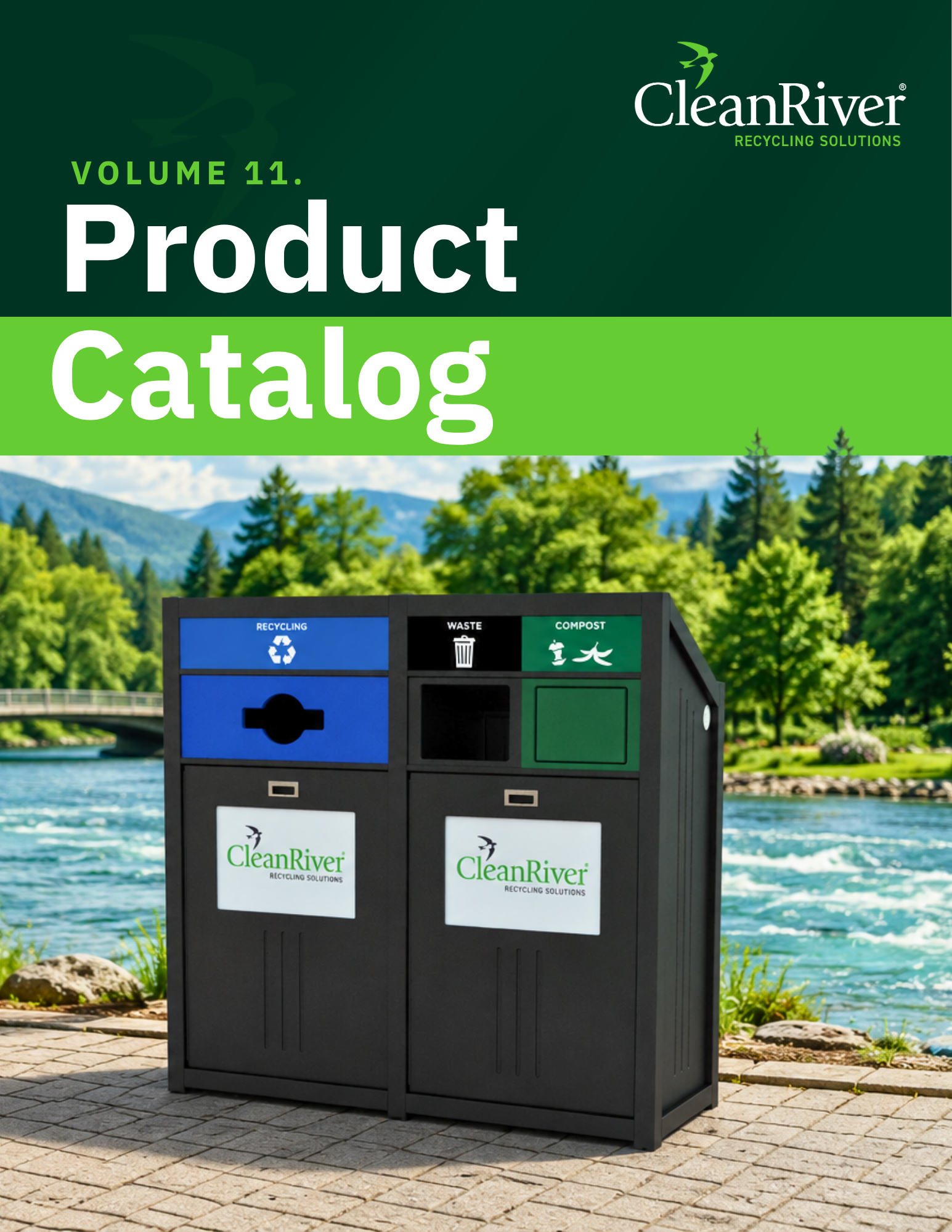
| 3 | Install co-located three-stream collection stations in convenient locations. “Convenient” means where people actually are when they generate waste, not a back room or basement that residents or employees have to hunt for. CleanRiver’s multi-stream stations are configurable for exactly this kind of three-stream setup, with the capacity and lid design matched to the volume and material type at each location. |
| 4 | Post clear signage at every collection point. URCO explicitly requires posted instructions explaining how to sort. Signage needs to be visual, specific to the materials your users actually generate, and placed at eye level where people can see it before they’re already mid-disposal. Generic printed signs won’t cut it in a high-turnover building or a busy restaurant. CleanRiver’s custom signage panels integrate directly onto station frames and can be tailored to the exact materials your building generates. |
| 5 | Create your Waste Diversion Plan and keep records. URCO requires covered properties to maintain a Waste Diversion Plan and retain hauling records. This doesn’t have to be a complex document, but it needs to exist and be available if the city asks for it. For construction projects, this must be submitted before permit issuance along with your performance security deposit. |
| 6 | Train your staff, tenants, and event volunteers. The ordinance puts responsibility on the building owner, property manager, or event organizer not on individual users. But contamination in the organics stream is the biggest operational failure point in programs like this, and it’s almost always caused by people not understanding what goes where. A brief training session, a well-written handout, or a short video shown to new tenants at lease signing goes a long way. One Denver community advocate suggested making recycling orientation a condition of lease signing. That’s exactly the kind of ownership mindset the ordinance is built around. |
Denver’s Waste No More ordinance passed with 70% of the vote because residents understood intuitively that a city generating this much landfill waste needed a structural fix, not just a recycling awareness campaign. URCO is that fix. It’s mandatory, it’s in effect, and the City is actively building the compliance infrastructure to track it.
The good news is that getting compliant doesn’t have to be complicated. The core requirements are clear: three streams in convenient locations, proper signage, a licensed hauler, and documentation. The harder part, honestly, is making it work day-to-day keeping bins from overflowing, keeping the organics stream clean, and keeping residents and employees engaged enough to sort correctly. That’s where the right physical infrastructure matters enormously. Bins that are well-placed, clearly labeled, and right-sized for the volume they’re handling do most of that work automatically.
Denver is targeting 70% waste diversion by 2032. The city is currently at less than 30%. That gap doesn’t close without every covered property doing its part. Whether you’re a property manager putting together a three-stream setup for the first time, a restaurant operator figuring out how to make organics collection work in a busy kitchen, or an event organizer planning your waste footprint for the next permitted event, the time to act is now. September 1 has passed. The window for “we’re working on it” is closing.
Official Denver URCO Resources
Denver Universal Recycling and Composting Ordinance City of Denver Official Page
About the Author
Andrew Bell
Vice President, Sales and Marketing — CleanRiver Recycling Solutions
Andrew Bell has spent more than 20 years helping facilities managers, property operators, and sustainability teams build recycling and waste programs that actually work. As Vice President of Sales and Marketing at CleanRiver Recycling Solutions, he works daily with organizations navigating exactly the kind of compliance challenges Denver’s Waste No More ordinance is now creating — figuring out what bins they need, where to put them, how to label them, and how to make the whole system work for the people using it.
Andrew has guided clients across multi-family residential, commercial, food service, and events sectors through municipal recycling mandates in cities and states across North America. He understands the operational realities that sit behind compliance deadlines: tight budgets, limited storage space, high resident or tenant turnover, and the contamination challenges that come with organics programs in shared buildings. That practical experience shapes how CleanRiver approaches every customer conversation.
A graduate of Graceland University and a two-time National Sales Manager of the Year, Andrew leads a team committed to turning regulatory pressure into operational results for CleanRiver’s customers across North America.
Need three-stream bins and signage for your Denver property?
CleanRiver designs multi-stream collection stations and custom signage built for exactly the compliance requirements URCO demands, for apartments, offices, restaurants, and events of every size.