
Share
9 min read
Mexico Just Changed the Rules on Waste. Here Is What Your Facility Needs to Do Next.
On January 19, 2026, Mexico published the General Law on Circular Economy (Ley General de Economía Circular, or LGEC) in the Official Gazette of the Federation. It came into force the very next day. For the first time, circularity is not a goal Mexico is working toward. It is a legal obligation organizations are already required to meet. If you manage a facility, run sustainability for a business operating in Mexico, or oversee a supply chain that touches the country, this law is now part of your compliance landscape.
Think about the scale of the problem the LGEC is trying to solve. Mexico generates more than 120,000 tons of waste every single day. Of that staggering volume, only around 2,394 tons per day are actually recovered and put back into productive use. That is less than 2%. The rest goes into landfills, onto streets, or into waterways. This is not a technology gap. Mexico has recycling infrastructure. The problem is that the regulatory framework, the economic incentives, and the physical collection systems needed to channel materials into that infrastructure have never been properly aligned. The LGEC is an attempt to fix all three at once.
If you are a facilities manager or sustainability director trying to figure out what this means for your day-to-day operations, you are in the right place. This blog breaks down what the LGEC actually says, what it requires of different types of organizations, and how CleanRiver’s multi-stream collection stations and signage systems help you build the physical infrastructure the law now demands, before the compliance window closes.
You can read the full text of the law here:
Ley General de Economía Circular (LGEC) Texto Oficial (PDF)
Why This Law Is Different From Everything That Came Before
From waste management to product lifecycle responsibility
Mexico has had environmental waste legislation since 2003, when the General Law for the Prevention and Integral Management of Waste (LGPGIR) was enacted. That law dealt with waste after it existed how to collect it, treat it, and dispose of it. It was always a downstream fix. The LGEC takes a completely different approach. It goes upstream, to the point where a product is being designed, manufactured, and placed on the market. The question changes from “how do we manage this waste?” to “why does this waste exist at all?”
Under the new law, the circular economy is formally defined as a production and consumption model that keeps materials in use as long as possible, minimizes what gets thrown away, and returns materials to the productive cycle when their first life ends. It includes legally binding principles like reparability, modularity, traceability, and Extended Producer Responsibility (EPR). These are not voluntary commitments. They are requirements embedded in federal law.
The LGEC also amends two other major laws: the LGPGIR (so existing waste management rules now incorporate circularity principles) and the General Law of Ecological Balance and Environmental Protection (LGEEPA). Read together, these three instruments cover a product’s entire life, from raw material extraction all the way through to what happens after the last user is done with it.
The Core Shift
Under Mexico’s old framework, your compliance obligation ended when waste left your site. Under the LGEC, it starts at the drawing board. If you design it, manufacture it, or import it into Mexico, you are now part of the recovery equation.
What the LGEC Actually Sets Up
Five interlocking elements that make the law work
1. A National Circular Economy System
The law creates the Sistema Nacional de Economía Circular, led by SEMARNAT (Mexico’s Ministry of Environment and Natural Resources) and made up of federal agencies and state representatives. Its job is to coordinate national policy and bring government, industry, and civil society to the table. Every state and municipality has 180 days from January 20, 2026 to update their local legislation to match the federal standard. If they do not, federal LGEC provisions kick in automatically at the local level. There is no opting out.
2. Extended Producer Responsibility
This is the heart of the LGEC. Article 36 requires that all productive sectors design products with circularity in mind, where it is environmentally, technically, and economically feasible, and implement EPR schemes according to sector-specific agreements issued by SEMARNAT.
In plain terms: if you make it or import it, you are now responsible for what happens to it after the customer is done with it. Not just for managing waste at the end of the chain, but for the design choices that determine whether recovery is even possible. Reparability. Modularity. Lifespan. Use of recycled inputs. These are now legal criteria, not marketing talking points. EPR applies to any organization that manufactures in Mexico, imports products or raw materials, or sells physical goods in the Mexican market.
One important nuance: specific EPR obligations do not switch on automatically today. They activate sector by sector as SEMARNAT publishes General Implementation Agreements. The National Circular Economy Program, due within 180 days of the Regulations, will name priority sectors for 2026-2030. Plastics are already confirmed as first in line.
3. Circular Management Plans and the Registry
Once a sector falls under an EPR Implementation Agreement, producers and importers in that sector must register a Gestión Circular (Circular Management Plan) in the new Registro de Economía Circular. Think of this plan as a commitment document it maps the environmental footprint of your products and shows how you will meet circularity targets. The Registry is a public platform, which means your progress (or lack thereof) becomes visible to regulators, investors, and supply chain partners. The metrics being tracked include carbon footprint, water footprint, and material utilization rates.
4. A National Seal That Opens Procurement Doors
The LGEC creates the Distintivo Nacional de Economía Circular, a government-issued seal for products and services that meet circularity criteria. Here is why it matters commercially: holders of the Distinction receive preference in public procurement. In a country where government purchasing represents a significant share of demand across many sectors, that is a meaningful competitive advantage. The Distinction is tied to voluntary environmental audits and renews every three years.
5. Real Penalties for Non-Compliance
This is not a law with soft teeth. Non-compliance can result in fines ranging from 30 to 50,000 days of minimum wage, temporary or permanent closure of facilities, and suspension or revocation of operating licenses, permits, and concessions. Hazardous waste mismanagement is treated as a direct administrative infringement under the LGEC enforcement framework. These consequences apply once sector-specific EPR agreements are in force for a given sector, which is why organizations should be building their compliance infrastructure now rather than waiting for the agreements to land on their desk.
tons of waste generated in Mexico per day
currently recovered for recycling or reuse
waste recovery target for Mexico City by 2030
Mexico City Goes Further: Mandatory Waste Separation Starting 2026
The capital city acts in parallel with the federal law
The federal law does not operate in isolation. Mexico City has moved at the same time with its own program that turns the LGEC’s principles into a street-level reality. Since January 1, 2026, waste separation has been mandatory in the capital under the Transforma Tu Ciudad initiative, led by Mayor Clara Brugada and run through the city’s new Integrated Waste Management Agency (AGIR).
The program is simple in concept and significant in scale. Every waste generator in Mexico City is now required to separate into three streams: organic waste, recyclable inorganic waste, and non-recyclable inorganic waste. Each stream has a collection day. The city has already distributed color-coded containers to households to make it work. The goal is to go from roughly 15% proper separation today to recovering at least 50% of the city’s 8,600 daily tons of waste by 2030, while reducing landfill volume by half and cutting emissions by 35%.
To make sure the processing infrastructure can keep up, Mexico City is putting MX$150 million into upgrading the Bordo Poniente recycling plant and expanding overall capacity by 50%. When a city spends that kind of money on recovery infrastructure, it is sending a clear signal: the separated materials are coming, and the system needs to be ready to receive them. Organizations that get their source separation right now are positioned to deliver high-quality material into a processing system being built to handle exactly that.
Color Code Mexico City 2026
Green container: organic waste (food scraps, garden waste). Gray container: recyclable inorganic waste (plastic bottles, cans, cardboard, glass). Orange container: non-recyclable inorganic waste (landfill). These color designations apply across Mexico City’s mandatory separation scheme and should be reflected in the signage and bin selection of any facility operating in the capital.
How CleanRiver Helps
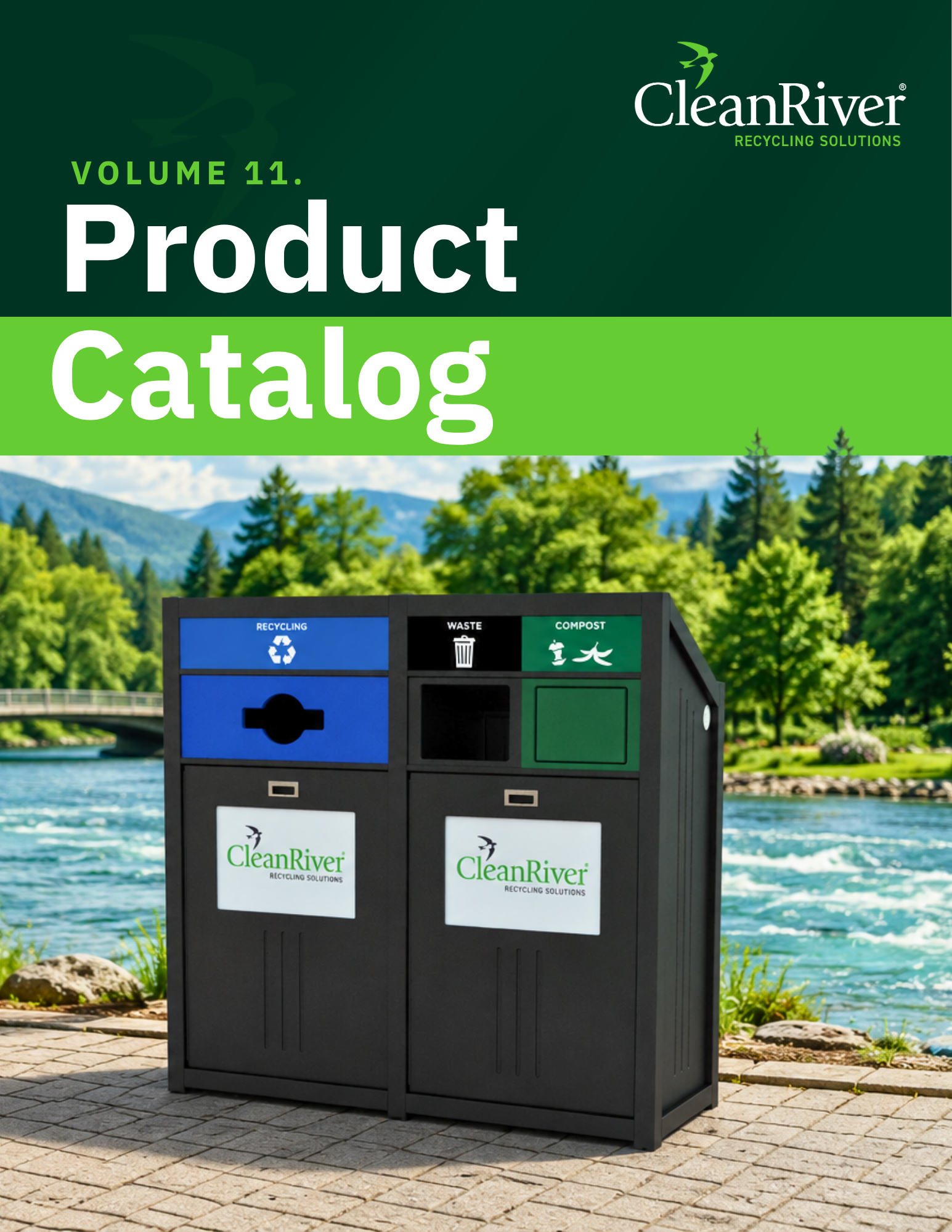
CleanRiver’s multi-stream recycling stations are fully configurable for three-stream separation, with lid colors, signage panels, and aperture shapes matched to the Mexico City color scheme and the LGEC’s source separation requirements. Whether you are outfitting a single office floor or a multi-building campus, CleanRiver provides the collection infrastructure, custom signage, and program support to meet the law’s demands from day one. Talk to a CleanRiver specialist today.
The Implementation Timeline: What Happens When
Progressive rollout with critical milestones
The LGEC works in stages. The framework is live and binding now, but sector-specific obligations do not all activate at once. They roll out as SEMARNAT publishes the secondary instruments required to trigger them. Knowing where each deadline falls gives you the planning window you need:
| Milestone | Date / Deadline | What It Means |
|---|---|---|
| LGEC published and enters into force | January 19–20, 2026 | Framework law is legally binding; general principles and obligations apply; specific EPR sectors not yet triggered |
| State harmonization deadline | July 18, 2026 | 180 days for states to align local legislation with LGEC; federal provisions apply directly where states fail to act |
| LGEC Regulations published | Within 180 days of entry into force | Operational criteria, procedures, and targets defined; National Circular Economy Distinction becomes operational |
| National Circular Economy Program | Within 180 days of Regulations | Identifies priority sectors for 2026-2030; plastics explicitly named; first EPR Implementation Agreements follow |
| Sector-specific EPR obligations activate | As SEMARNAT publishes General Implementation Agreements by sector | Registration, Circular Management Plans, and recovery targets become mandatory for each covered sector upon publication |
| Landfill conversion begins | Within 5 years of entry into force | All landfill facilities must begin a progressive conversion process toward circular waste management models |
So What Does This Actually Mean for Your Facility?
Practical implications for waste infrastructure, sourcing, and reporting
If your facility is not a producer or importer, you are not yet required to file a Circular Management Plan or register in the national registry. That relief, however, comes with an asterisk. The LGEC directly strengthens the duties of responsible waste management, source separation, and circular recovery for all generators, and ties those duties to the enforcement framework of the updated LGPGIR. The floor for what is expected of every facility in Mexico just got higher.
There is also a commercial dimension worth paying attention to. As producers and importers build EPR recovery systems, they need places to recover materials. Buildings and facilities that already practice proper source separation become attractive partners in that recovery network. A commercial building with organized, multi-stream collection that reliably separates clean recyclables is an asset to an EPR program. One that sends everything mixed to landfill is a liability.
Source Separation: No Longer Optional
Between the LGEC and Mexico City’s mandatory separation program, source separation has moved from best practice to legal requirement. In Mexico City, that shift happened on January 1, 2026. For facilities in other states, the 180-day state harmonization deadline means similar local requirements are arriving within months.
Every office, school, commercial building, and manufacturing site in Mexico needs the physical infrastructure to handle at least three waste streams: organic, recyclable inorganic, and non-recyclable. The bins need to be co-located, clearly labeled, and color-coded to match the scheme in effect in your jurisdiction. Mexico City’s green/gray/orange system is the current municipal standard. CleanRiver’s multi-stream stations are built to be configured for exactly this kind of regulatory deployment, with stream count, capacity, color, aperture design, and signage tailored to the requirements of the program you are running.
ESG Reporting Gets More Specific
The LGEC introduces a more granular set of environmental performance metrics: carbon footprint, water footprint, and material utilization rates are all specifically referenced as indicators that feed into official registries. If you are already reporting under international ESG frameworks, these metrics are broadly compatible with what you are likely measuring today. The gap is usually not in the framework but in the data quality at the point of collection.
That is why the physical infrastructure matters for ESG too. A CleanRiver multi-stream station that properly separates organic, recyclable, and non-recyclable waste gives you the granular diversion data by material type that the LGEC registry will ultimately expect. Contaminated mixed loads produce none of that. Start building clean separation now, and the reporting infrastructure builds itself.
Six Things to Do Before the EPR Agreements Land
| 1 | Audit your waste streams. Walk your facility and map what materials are generated, how they are collected, and where they actually go. Most organizations discover a significant gap between what they think is being separated and what is actually happening on the floor. That gap is what the LGEC is designed to close. |
| 2 | Put three-stream stations where people generate waste. Bins for organic, recyclable, and non-recyclable waste need to be co-located at every generation point, not just in designated areas people rarely visit. CleanRiver’s configurable multi-stream stations handle any stream count and color combination, and they are built for compliance deployments like this one. |
| 3 | Fix your signage. A bin with the wrong label drives contamination as reliably as no bin at all. Labels need photos of accepted items and photos of rejected items, mounted at eye level. Generic stickers downloaded from the internet are not enough. CleanRiver’s custom signage panels mount directly onto station frames and are designed around the specific items causing the most confusion in your facility. |
| 4 | Start measuring what you divert. The LGEC registry will require verified data on material utilization. Request monthly tonnage reports from your hauler broken down by stream and start tracking them now. Building six months of clean data before the registry opens is far better than scrambling to reconstruct it from memory afterward. |
| 5 | Check your products against circular design criteria. If your organization manufactures or imports goods sold in Mexico, get ahead of EPR by mapping your product lines now. Which ones involve plastics? Which use virgin materials where recycled alternatives exist? Identifying your exposure before SEMARNAT publishes the agreements is the difference between a planned transition and a reactive scramble. |
| 6 | Watch the Official Gazette. The mid-July 2026 deadline is when the 180-day state harmonization window closes and when SEMARNAT’s Regulations and the National Circular Economy Program are expected. The Regulations will trigger the National Circular Economy Distinction process. The Program will name the first EPR sectors. Subscribe to DOF alerts or assign someone to monitor it. You want to know what is coming the day it is published, not a month later. |
Mexico is not the first country to go down this road. The European Union’s circular economy framework, Canada’s federal recycling regulations, and several U.S. state-level EPR laws have all followed a similar pattern: framework law first, sector-specific obligations rolling in behind it. The organizations that come out ahead in those environments are the ones that treat the framework law as the starting gun, not the finish line.
The bin you put in your break room is a small thing. But multiply it across every building in Mexico, and you are looking at the physical infrastructure of a circular economy taking shape or failing to take shape at the most granular level possible. Getting the bins right, the labels right, and the data right is not bureaucratic box-ticking. It is how the law becomes real in practice.
CleanRiver has been helping organizations in North America build this kind of compliant, high-performance waste infrastructure for decades. If the LGEC has moved this from a “someday” question to a “right now” one for your team, we are ready to help you figure out where to start.
Read the Full Law
Ley General de Economía Circular (LGEC) Official Text, Cámara de Diputados de México (PDF)
Ready to build three-stream compliance infrastructure?
CleanRiver designs multi-stream recycling stations for facilities preparing for LGEC source separation requirements with signage, color-coding, and capacity matched to your specific environment.