
Share
Regulatory Update · Washington State
Washington’s Organics Laws: Is Your Business Ready?
HB 1799, SB 5731, and HB 1497 have reshaped how businesses, buildings, and municipalities manage organic waste in Washington. Here’s what’s changing — and how to stay ahead of it.
📅 Updated May 2026 🕒 8 min read 📌 Washington State
⚠️
Is your organics program ready for 2026? Beginning January 1, 2026, businesses in designated Business Organics Management Areas that generate 96 gallons or more of organic material waste per week must arrange for organics management service. Now is the time to prepare your collection, signage, and diversion program.
The Big Picture
Washington is serious about keeping organics out of landfills
Organic materials — food scraps, yard waste, food-soiled paper — decompose in landfills and produce methane, a greenhouse gas more than 75 times as potent as carbon dioxide over a 20-year period. Washington set ambitious targets to address this: a 75% reduction in statewide organic waste disposal by 2030 (relative to 2015 levels) and 20% of previously disposed edible food redirected for human consumption by 2025.
To get there, three pieces of legislation form the backbone of Washington’s organics management framework: HB 1799 (2022), SB 5731, and the most recent update, HB 1497 (signed into law May 17, 2025). Together they create an enforceable, multi-year rollout of requirements that affect nearly every type of business and municipality in the state.
“This is a fundamental shift — from voluntary diversion to mandatory, enforceable compliance. The window for ‘we’ll get to it later’ has closed.”
Compliance Timeline
Key dates every Washington business should know
Jan 1, 2024
8+ cubic yards / week
Businesses generating at least 8 cubic yards of organic material waste per week must arrange organics management service.
Jan 1, 2025
4+ cubic yards / week
Requirement expands to businesses generating at least 4 cubic yards of organic material waste per week.
Jan 1, 2026
96+ gallons / week
Threshold drops significantly — most food-generating businesses will fall under this volume. The Ecology Department may adjust this threshold by rule.
Apr 1, 2027
Curbside organics collection required
Jurisdictions must provide year-round source-separated organic waste collection to all single-family residents and most nonresidential customers generating more than 0.25 cubic yards/week.
Jan 1, 2028
Standardized container colors & labels
All solid waste containers under 101 gallons must use standardized colors: gray/black for trash, blue for recycling, green or brown for organics.
Apr 1, 2030
Mandatory participation — no opt-out
Organics collection becomes non-elective for curbside customers. Residents must use organics bins for organic materials unless managing waste on-site or self-hauling.
What Changed with HB 1497
The 2025 update that tightens the screws
Signed by Governor Ferguson in May 2025, HB 1497 represents the most significant refinement to Washington’s organics framework since HB 1799 passed in 2022. Here’s what it adds:
Standardized Bin Colors
Beginning January 1, 2028, containers under 101 gallons must follow a statewide color code — making correct sorting intuitive and reducing contamination.
Formal Enforcement Penalties
Starting July 1, 2026, non-compliant businesses face escalating daily fines after two written notices. Small businesses capped at $10,000/year in total penalties.
Multifamily Requirements
Local solid waste plans submitted after July 2026 must include timelines to phase in organics collection for multifamily properties. New builds must be ready from day one.
Building Code Updates
The state building code must now ensure new multifamily and commercial buildings allocate sufficient space for organic waste storage — an infrastructure fix baked in at construction.
School Food Waste
New requirements for the Office of Superintendent of Public Instruction to develop food waste reduction curricula and best practices for schools by January 2027.
Updated Grant Eligibility
The Organics Grant Program now covers businesses, local governments, tribes, nonprofits, and organics facilities — with enforcement costs as an eligible expense.
Enforcement
What non-compliance actually costs
Under HB 1497, the enforcement process is defined and escalating. Before any fines are issued, a business must first receive a notification letter by certified mail, then a notice of violation. Only after both steps does the penalty clock start — on July 1, 2026.
| Violation | Min. Daily Penalty | Notes |
|---|---|---|
| 1st violation | $500 / day | Begins July 1, 2026 after two prior written notices |
| 2nd violation | $750 / day | Enforced by local health departments or jurisdiction |
| 3rd+ violation | $1,000 / day | Appealable to Pollution Control Hearings Board |
| Small business cap | $10,000 / year max | As defined under RCW 19.85.020 |
Jurisdictions enforcing the requirements cannot charge permit holders a fee to cover their own administration costs — but they can and will issue fines for non-compliance.
Exemptions
Who may be excluded — and under what conditions
Not every business is automatically subject to penalties. Exemptions exist at both the jurisdiction level (no available haulers, no processing capacity) and the business level. A business is not required to comply if:
- Organic materials are managed on-site (e.g., composting, dehydration)
- Materials from food or fiber growing/harvesting are managed by another agricultural business
- Organic materials are sold or donated to another business for off-site use
- Materials were generated by a natural disaster or infrequent unpreventable event
- Materials result from a food safety event (e.g., a product recall requiring landfill disposal)
- The business self-hauls organic waste directly to a permitted organics management facility
Jurisdiction-wide exemptions must be requested by the local government and confirmed by the Washington Department of Ecology. Individual businesses cannot apply for a jurisdiction-level exemption on their own.
The Container Color Standard
A simple system — but it requires the right bins
One of the most tangible changes from HB 1497 is a statewide bin color system, effective January 1, 2028. The goal is to cut contamination — the number-one reason organics loads get rejected at processing facilities — by making correct sorting intuitive at a glance.
⬛ Gray or Black — Trash
General solid waste. May not be used for organics or recyclables in jurisdictions with separate collection.
🟦 Blue — Recycling
Source-separated recyclable materials only. Contents must be destined for a materials recovery facility.
🟩 Green or Brown — Organics
Source-separated organic materials destined for an organics management facility. Carpets and hazardous wood waste are prohibited.
Existing functional containers do not need to be replaced immediately — but any container purchased after August 1, 2025 must comply with the new color standard.
How CleanRiver Can Help
Built for exactly this moment
For over 35 years, CleanRiver has designed recycling and waste diversion systems that actually work — not just in theory, but in the facilities, offices, and public spaces where sorting decisions get made every day. Washington’s new requirements aren’t a burden if your system is set up correctly from the start.
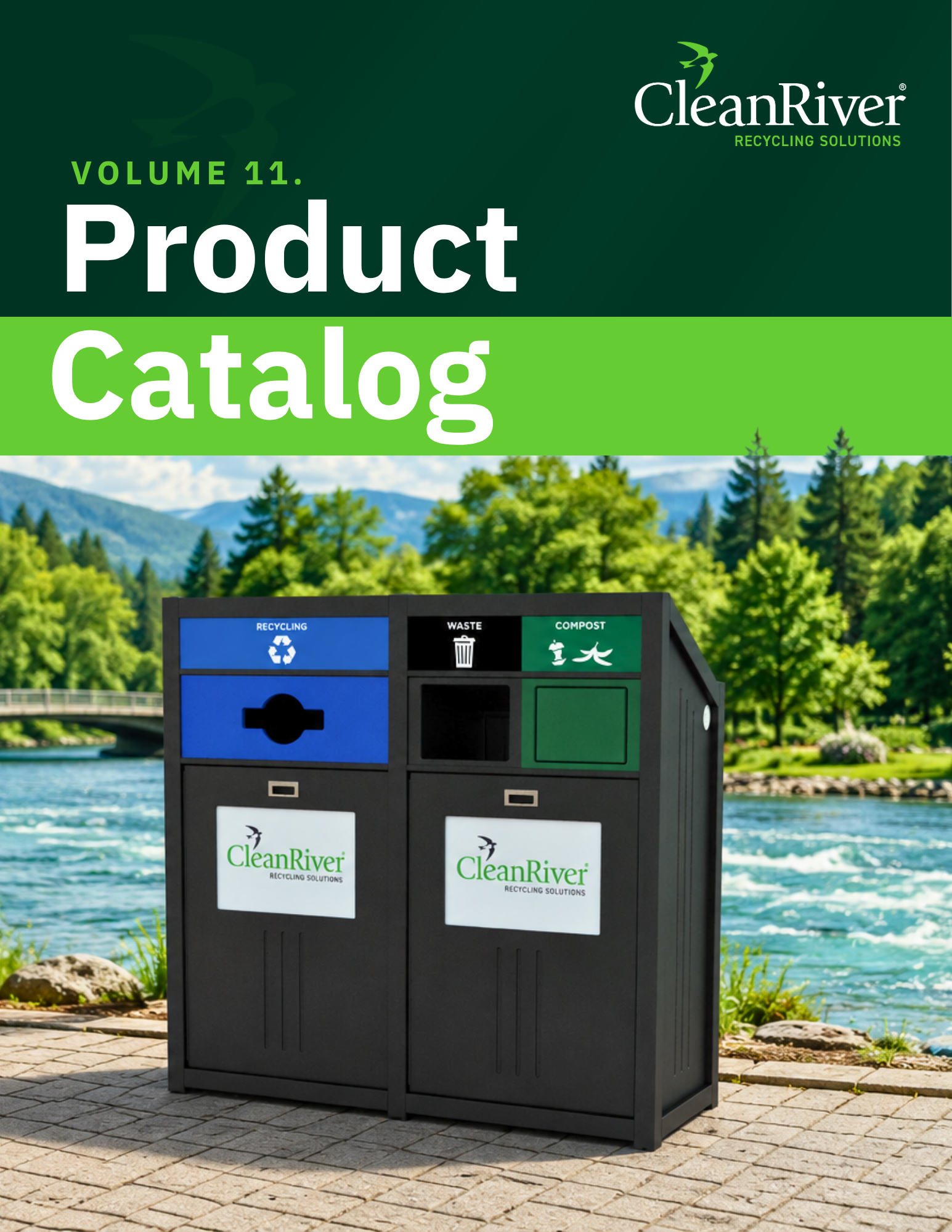
- Color-coded containers meeting the 2028 standard
- Custom labeling in multiple languages
- Indoor and outdoor organics bins sized to your volume
- Signage systems that cut contamination at the source
- Program audits to identify compliance gaps
- Staff training and educational materials
Funding Available
Grants to help offset your compliance costs
Washington has made funding available to help businesses and municipalities meet these requirements. Key programs include:
- King County Re+ Grants — $2M+ per cycle for diversion, reuse, and organics programs. Private partners are often required for execution.
- Re+ Seed Grants — Up to $10,000 per project for pilots and new diversion models — ideal for testing on-site composting or organics management approaches.
- Ecology Public Participation Grants — Up to $120,000 for education and compliance programs.
- NextCycle Washington — Circular economy innovation and pilot programs, particularly useful for novel organics management approaches.
- HB 1497 Organics Grant Program — Businesses subject to organic material management requirements are now explicitly eligible. Eligible expenses include education, outreach, infrastructure, and enforcement costs.
Bottom Line
The time to act is before the fine arrives
Washington’s organics management framework is the most comprehensive mandatory diversion program the state has ever implemented. The phased rollout has given businesses time to prepare — but with the 96-gallon threshold arriving January 1, 2026, that window is closing fast for a significant share of food-generating businesses across the state.
The businesses that navigate this best will treat it as a systems challenge, not a paperwork challenge. That means the right containers, clear labels, staff who know what goes where, and a hauler relationship that actually delivers organic material to a permitted facility.
CleanRiver can help you build that system — whether you’re a single facility or a multi-site operation standardizing compliance across locations. Reach out to our team to get started.
CleanRiver Recycling Solutions35+ years helping facilities divert waste from landfill · cleanriver.com
Washington State HB 1497 HB 1799 Organics Compliance Food Waste